

 Admin
Admin
A coalition of civil society organisations has raised serious concerns over what it described as a growing governance and accountability crisis within the National Hajj Commission of Nigeria (NAHCON), warning that the dispute could undermine public trust, disrupt Hajj preparations and damage Nigeria’s international standing.
In a statement issued on Tuesday and signed by Muhammad Nda Auwal, the coalition said it was compelled to speak out as a group committed to accountability, legality and institutional stability in public institutions of the Federal Republic of Nigeria.
The coalition said it had carefully reviewed the ongoing dispute within NAHCON and expressed alarm at the conduct of certain Board members, which it said poses a grave threat to the smooth administration of the nation’s Hajj operations.
“Our position is clear,” the statement said. “Board members who are subjects of ongoing or inherited cases with the Economic and Financial Crimes Commission (EFCC) have lost the moral standing to sit in judgment over the management of the Commission.”
According to the group, individuals facing unresolved integrity questions cannot credibly claim oversight authority, stressing that accountability must begin with those who seek to enforce it.
The coalition faulted what it described as a pattern of insinuations, allegations and public accusations by some Board members, noting that such claims were not backed by verifiable evidence as required by law.
“Where misconduct is alleged, the law demands specifics — dates, transactions, contract references and audit queries,” the statement said, adding that none of these had been presented. It warned that the absence of concrete evidence weakens the allegations and reflects a disregard for due process.
The group further outlined what it described as established operational facts within NAHCON, including that all financial payments require endorsement by the Commissioner for Planning, Research, Statistics, Information and Library Services (PPMF), the Accounts Department and Internal Audit. It also noted that procurement decisions are committee-based, properly documented and subject to statutory review.
The coalition alleged that some of the cases being referenced with the EFCC were inherited and involved Commissioners who are now attempting to “posture as moral arbiters,” despite their own unresolved issues. It also stressed that Board members have no statutory power under the NAHCON Act to pass or communicate a vote of no confidence in the Chairman.
Beyond the allegations, the coalition expressed deeper concern over what it described as internal sabotage within the Commission. These, it said, include unauthorized postings, issuance of official correspondence without executive approval, open defiance of lawful directives and attempts by Board members to assume operational roles not provided for by law.
“This conduct amounts to insubordination and institutional vandalism,” the statement declared.
The civil society groups therefore demanded the immediate resignation of all Board members with pending or inherited EFCC cases, insisting that oversight cannot be credible when clouded by unresolved investigations.
They also called for the resignation of any Board member involved in issuing what they described as an unlawful vote of no confidence outside established legal procedures.
“If they truly believe in accountability, they must submit themselves to it,” the coalition said.
The group emphasised that Nigeria’s Hajj administration is a national trust that goes beyond personal ambition or power struggles, noting that it involves human lives, sensitive diplomacy and international obligations.
“The Commission needs stability. The law must prevail. Those without clean hands must step aside,” the statement said, warning that anything short of this would suggest that the crisis is driven not by accountability, but by a struggle for control.
The coalition urged the Presidency and other relevant authorities to intervene decisively in the national interest to restore stability and confidence in NAHCON.
 NAWOJ, Rights Groups Seek Justice Over Alleged Abuse of Four Children in Kano School
  Kano State Government Reaffirms Commitment to Reducing Child Malnutrition
  Stop dragging issues with pilgrims on the issue of Accommodation at Arafat ,Minna – NAHCON warns State Pilgrims Welfare Boards
  CS-SUNN Trains Stakeholders in Kano on Nutrition Budget Tracking System to Strengthen Nutrition Financing in Nigeria
  APC Primary: Tinubu Wins Across 44 Kano LGAs
 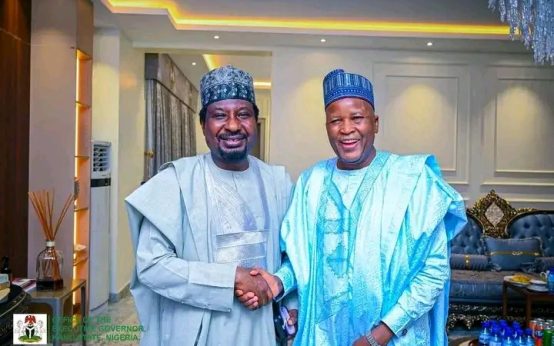 DSP Barau, HE Garo and HE Gwarzo Stand Together: Who Stands Aloof?
  NAWOJ, Rights Groups Seek Justice Over Alleged Abuse of Four Children in Kano School
  Kano State Government Reaffirms Commitment to Reducing Child Malnutrition
  Stop dragging issues with pilgrims on the issue of Accommodation at Arafat ,Minna – NAHCON warns State Pilgrims Welfare Boards
  CS-SUNN Trains Stakeholders in Kano on Nutrition Budget Tracking System to Strengthen Nutrition Financing in Nigeria
  APC Primary: Tinubu Wins Across 44 Kano LGAs
  DSP Barau, HE Garo and HE Gwarzo Stand Together: Who Stands Aloof?