
 Admin
Admin Key actors in Kano State’s water, sanitation and hygiene (WASH) sector have resolved to overhaul the state’s Open Defecation Free (ODF) Roadmap, citing persistent sanitation gaps in 12 of the 44 local government areas.
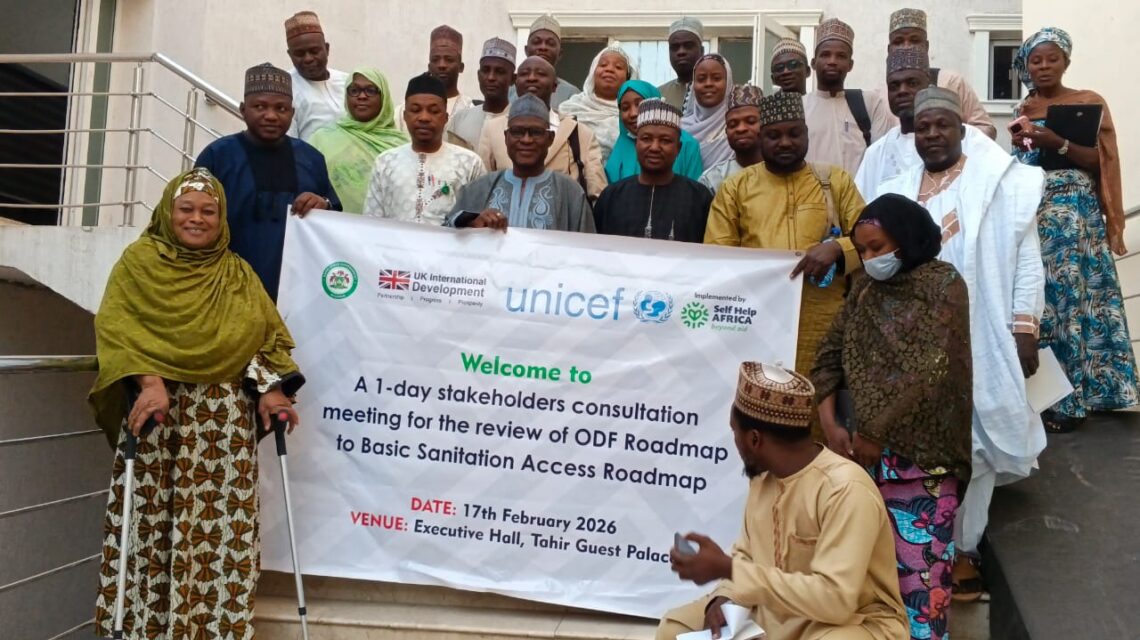
The resolution was reached at a one-day stakeholders’ consultative meeting held at Tahir Guest Palace, Kano, convened by the Kano State Task Group on WASH with support from Self Help Africa and UNICEF.
The meeting brought together representatives of government ministries, departments and agencies, civil society organisations, private sector operators, academia and religious leaders to review the 2022–2025 ODF Roadmap and chart a new course toward a Sustainable Basic Sanitation Access Roadmap (2026–2031).
Lingering Public Health Concerns
Participants acknowledged that sanitation remains a major public health concern in Kano State and Nigeria at large. Despite progress recorded in some areas, wastewater and faecal sludge continue to contaminate water sources, while access to improved toilet facilities remains inadequate in many communities.
Stakeholders noted that weak hygiene education, poor enforcement of sanitation regulations and insufficient toilet infrastructure have compounded the problem. They stressed that urgent and coordinated action is needed to prevent waterborne diseases and environmental degradation.
According to discussions at the meeting, improved sanitation coverage must go beyond toilet construction to include efficient human waste collection, transportation, treatment and safe reuse or disposal through innovative, context-specific approaches.
Review of the Existing Roadmap
The workshop provided a retrospective review of the current ODF Roadmap (2022–2025) and identified gaps that must be addressed in the next phase.
Among the key challenges highlighted were: Inadequate resource mobilisation for sanitation programming
Limited private sector participation in the sanitation value chain ,Lack of institutionalisation of Market-Based Sanitation (MBS) at scale ,Inappropriate technology options that fail to address the needs of women, girls, children, persons with disabilities and other vulnerable groups.
Others includes Weak community response to climate-resilient sanitation approaches ,Insufficient data for evidence-based decision-making.
Participants agreed that these gaps have slowed progress toward achieving and sustaining ODF status across the state.
A major highlight of the meeting was the emphasis on Market-Based Sanitation (MBS) as a strategy to drive sustainability. Stakeholders stressed the need to create an enabling environment that attracts private investment and promotes innovation within the sanitation sub-sector.
The forum also underscored the importance of gender equity and social inclusion, calling for sanitation facilities and programmes that are responsive to the needs of women, girls and persons with disabilities.
Climate resilience featured prominently in deliberations, with experts urging communities to adopt sanitation technologies capable of withstanding flooding and other climate-related challenges.
At the end of deliberations, the meeting adopted several recommendations to guide the development of the 2026–2031 Sustainable Basic Sanitation.
Access Roadmap:
Increase and prioritise resource mobilisation for sanitation programming
Engage the private sector more effectively in the sanitation value chain
Institutionalise Market-Based Sanitation at scale
Promote gender-equitable and socially inclusive sanitation initiatives
Advance climate-resilient sanitation approaches informed by research and verifiable data
Develop a robust sanitation information management system, including a comprehensive monitoring and evaluation framework
Commitment to a Cleaner Kano
In their closing remarks, stakeholders reaffirmed their collective commitment to collaborate on the development and implementation of the new roadmap.
They pledged to intensify advocacy, strengthen partnerships and ensure accountability in the quest to achieve and sustain Open Defecation Free status across Kano State.
The communiqué was endorsed by members of the Communiqué Committee, including Ahmad Tijjani Ya’u of the Ministry of Information and Internal Affairs, Aisha Umar Haza of the Ministry of Health, and Rabi’u Dahiru Iliyasu of the Office of the Secretary to the State Government.
 Ambassador Dr. Amina Umar Namadi: A First Lady Defined by Compassion, Service, and Humanity
  Police Rescue Abducted Three-Day-Old Baby, Arrest Two Suspects in Nasarawa
  Governor Yusuf Mourns Alhaji Nuhu Dantani
  ADC Leaders Reject INEC Decision, Vow to Resist, Mobilise Support in Otukpo
  Police Disburse ₦9.26m to Families of Fallen Officers in Kano
  Ambassador Dr. Amina Umar Namadi: A First Lady Defined by Compassion, Service, and Humanity
  Police Rescue Abducted Three-Day-Old Baby, Arrest Two Suspects in Nasarawa
  Governor Yusuf Mourns Alhaji Nuhu Dantani
  ADC Leaders Reject INEC Decision, Vow to Resist, Mobilise Support in Otukpo
  Police Disburse ₦9.26m to Families of Fallen Officers in Kano