
 Admin
Admin By Hadiza Ado Jinta
The Institute for Agricultural Research (IAR), Samaru, in partnership with the African Agricultural Technology Foundation (AATF), has called on journalists to embrace factual, science-based reporting on biotechnology and genetically modified organisms (GMOs) to help dispel myths, misinformation, and fear surrounding the technology.
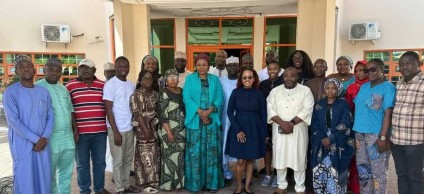
The call was made during a one-day capacity-building workshop for journalists from the North-West and North-Central regions, held in Zaria, Kaduna State.
The training focused on enhancing media professionals’ understanding of agricultural biotechnology, its benefits to farmers, and its role in achieving national food security and sustainable agricultural development.
Speaking at the event, Mrs. Irene Choge of AATF explained that the organization, established in 2003, was created to facilitate smallholder farmers’ access to modern agricultural technologies that improve productivity and livelihoods.
She said AATF’s two-decade journey has been dedicated to promoting innovation-driven solutions that tackle key productivity challenges facing African farmers. “Improved access to agricultural technology enables farmers to sustainably increase yield, reduce hunger and poverty, and contribute to a food- and nutrition-secure Africa,” she said.
Choge added that AATF’s current strategic direction, Scaling for Impact, focuses on commercialization and scaling up innovations to ensure they deliver tangible results to farmers across the continent.
Delivering a paper titled Understanding the Science, Dr. Mohammed Ahmad Yahaya of the Institute for Agricultural Research emphasized that concerns over the safety of GMOs are often fueled by misinformation rather than facts.
He noted that genetically modified crops developed in Nigeria are safe and designed to reduce farmers’ dependence on harmful insecticides. “GM crops like insect-resistant cowpea and maize were developed to withstand pests capable of destroying up to 80 percent of crops.
Farmers who once sprayed insecticides up to eight times can now spray only twice and still achieve better yields,” Yahaya said.
He explained that such innovations protect the environment while increasing productivity and income for smallholder farmers.
On her part, the Director-General of the National Biosafety Management Agency (NBMA), Dr. Halima Tahir, reaffirmed the federal government’s commitment to ensuring strict biosafety standards in the deployment of biotechnology in Nigeria.
She assured that every genetically modified crop approved in the country undergoes rigorous scientific assessment to guarantee safety for humans, animals, and the environment. “Our focus is to allay public fears and provide accurate information about the proven safety and benefits of GMOs,” she said, citing examples like Tela Maize, a newly introduced insect-resistant and drought-tolerant variety.
Tahir maintained that biotechnology offers solutions to persistent agricultural challenges such as food scarcity, malnutrition, and environmental degradation, adding that innovations like Bt Cowpea, Bt Cotton, and Tela Maize were developed to withstand pests and climatic stress.
Also speaking, Dr. Muhammad Hashim Suleiman of the Department of Mass Communication, Ahmadu Bello University, Zaria, urged journalists to approach science communication with professionalism and responsibility.
He said biotechnology reporting should be grounded in verified facts rather than driven by ideology or emotion. “Science communication is not about taking sides; it’s about helping the public make informed decisions,” he said. “When journalists choose facts over fear, they bridge the gap between the laboratory and the dinner table.” Suleiman added that agricultural biotechnology remains one of the most misunderstood scientific innovations globally, primarily due to poor communication.
He challenged journalists to engage scientists, regulators, and farmers directly to ensure balanced reporting. “Our job is to simplify complex science, not sensationalize it.
Nigeria needs informed journalism that empowers citizens to embrace innovations capable of transforming lives,” he concluded.
The training ended with a renewed commitment from participants to strengthen science journalism and support efforts that promote food security, innovation, and public awareness in Nigeria’s agricultural sector.
 FCAPT Kano Partners UNESCO, African Union, South Korea on BEAR III to Transform Agro-Training
  Food Security: HJRDA Reiterates Commitment to First Lady’s ‘Everyone Has a Garden’ Initiative
  NADF Engages Stakeholders to Strengthen Farm Input Delivery
  NEPC Moves to Curb Tomato Waste, Boost Value Chain in Kano
  Jigawa Targets 500,000 Hectres Of Rice Production By 2030
  DISCOURAGE IMPORT, ENCOURAGE EXPORT, FARMER ADVISES FEDERAL GOVERNMENT
  Ambassador Dr. Amina Umar Namadi: A First Lady Defined by Compassion, Service, and Humanity
  Police Rescue Abducted Three-Day-Old Baby, Arrest Two Suspects in Nasarawa
  Governor Yusuf Mourns Alhaji Nuhu Dantani
  ADC Leaders Reject INEC Decision, Vow to Resist, Mobilise Support in Otukpo
  Police Disburse ₦9.26m to Families of Fallen Officers in Kano