
 Admin
…….How Governor Abba Kabir Yusuf’s urban renewal drive is reshaping infrastructure, transportation and the landscape of Kano State
By Abdullahi Kano
Kano is a city with a rich history, a strong commercial identity and a reputation as one of Northern Nigeria’s most important economic centres. For generations, its ancient walls, traditional markets, bustling business districts and cultural heritage have defined its identity.
Today, however, the city is experiencing another phase of transformation, with increasing attention being given to modern infrastructure, improved road networks, flyovers, urban beautification, public spaces and recreational facilities.
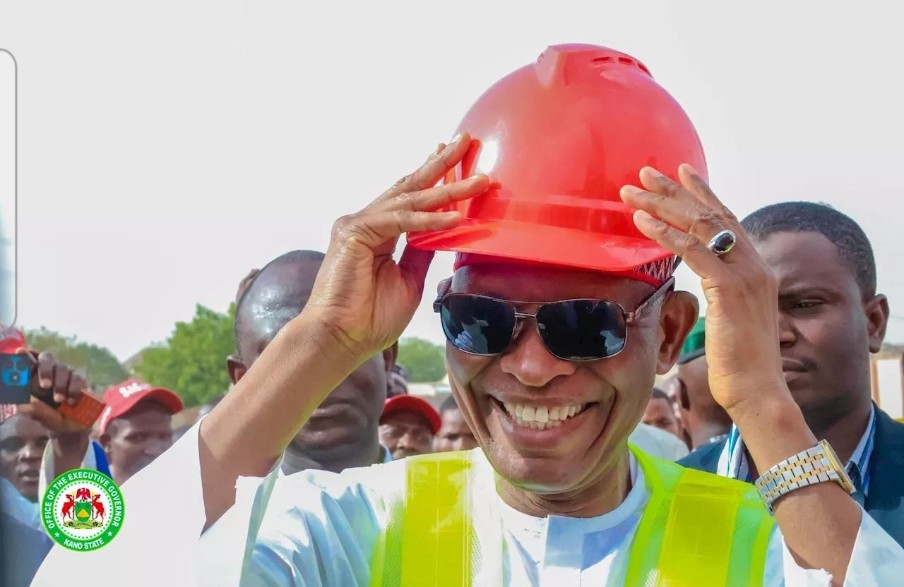
Since assuming office in May 2023, Governor Abba Kabir Yusuf has placed infrastructural development and urban renewal among the priorities of his administration, with an ambition to reposition Kano as a modern, accessible and economically competitive city.
The administration’s approach goes beyond the construction of roads. It seeks to address some of the longstanding challenges associated with an expanding urban population, including traffic congestion, deteriorating infrastructure, poor road connectivity and the need for more organised public spaces.
The scale of the programme is reflected in government figures released in July 2026, which indicated that more than 1,508 development projects, valued at over ₦928 billion, had been undertaken across the state’s 44 local government areas. Of these, 799 were reported completed, while 709 were at different stages of implementation. The figures cover several sectors, not infrastructure alone. Voice of Nigeria
One of the most visible components of the administration’s urban renewal programme is the rehabilitation and reconstruction of major roads within Kano metropolis.
In March 2025, Governor Yusuf flagged off the rehabilitation of 17 roads across the metropolitan area, beginning with Club Road in Nassarawa Local Government Area.
The road renewal programme covers important routes linking Club Road, Ashton Road, Airport Road and Murtala Muhammad Way. These roads serve residential neighbourhoods, commercial centres and major traffic corridors within the city.
The intervention is significant because Kano’s expanding population and growing commercial activities have placed increasing pressure on its existing road infrastructure. Rehabilitating these routes is expected to improve accessibility, reduce travel difficulties and support the movement of goods and services. Kano State Government +1
Another important intervention is the reconstruction of Zungeru Road in Sabon Gari, Fagge Local Government Area. The 3.6-kilometre project was flagged off in May 2025 to restore an important road that had remained abandoned after an earlier administration awarded it.
The project is expected to improve access within Sabon Gari, one of Kano’s important commercial and residential districts, while strengthening connections to neighbouring communities. Punch Newspapers
Other road interventions include reconstruction and rehabilitation around Farm Centre, Gwale, Sharada, Kofar Mazugal, Dorayi and several connecting routes. The Ministry of Works’ project registry also lists dual carriageway projects in local government areas such as Makoda, Rogo, Sumaila, Minjibir, Ajingi, Bagwai and Bunkure.
This indicates that the administration’s road programme is not limited to the state capital but extends to rural and semi-urban communities across Kano’s 44 local government areas. Kano State Ministry of Works
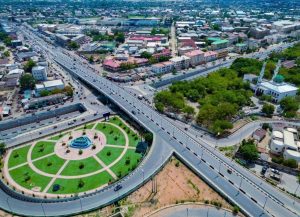
Perhaps the most prominent symbols of Kano’s ongoing infrastructural transformation are the interchange bridges at Kofar Dan’agundi and Tal’udu.
For decades, traffic congestion around these locations has been a familiar experience for motorists, commercial drivers, traders and commuters. The increasing number of vehicles, combined with the strategic importance of the routes, has made traffic management a major urban challenge.
In May 2024, Governor Yusuf laid the foundation for a three-layer interchange bridge at Kofar Dan’agundi, awarded to CCG Nigeria Limited at a reported cost of ₦15 billion.
The project comprises an overpass, an underpass and surface-level roads designed to improve traffic circulation and reduce unnecessary delays.
A second major interchange project at Tal’udu was also initiated, with an announced cost of approximately ₦12 billion. It is designed as a cloverleaf interchange to improve movement at the busy junction.
The two projects represented a combined investment of approximately ₦27 billion based on the original reported contract figures. Channels Television +1
In April 2026, the Federal Ministry of Information reported that the Speaker of the House of Representatives, Tajudeen Abbas, commended the Kano Government’s infrastructure projects during an inspection visit.
The report also quoted Governor Yusuf as saying that the Dan’agundi and Tal’udu interchange projects were nearing completion, with completion anticipated the following month. Federal Ministry of Info
Beyond their immediate transportation benefits, the bridges are expected to change the physical appearance of the city and provide a more organised system for managing traffic at some of its busiest intersections.
The government has also approved security plazas and CCTV installations around the two flyovers, according to a June 2026 report, indicating an effort to incorporate public safety into the management of major infrastructure. Tribune Online
Road expansion, pedestrian safety and traffic management
The development of a modern city requires more than constructing roads and bridges. It also demands adequate pedestrian facilities, functional traffic systems and infrastructure that accommodates different categories of road users.
In July 2025, the Kano State Executive Council approved a major road expansion project along Katsina Road, from Baban Gwari Roundabout to Mil Tara Junction.
The project, valued at ₦24.7 billion, includes five reinforced concrete pedestrian bridges.
The council also approved ₦7.8 billion for rehabilitation and asphalt overlay works covering the Rabiu Musa Kwankwaso Flyover, IBB Road, Kofar Mazugal Junction and Katsina Road, alongside ₦3.8 billion for the construction of 10 additional pedestrian bridges at strategic locations.
These interventions are particularly relevant to a city where pedestrian movement, commercial activities and vehicular traffic frequently compete for limited road space. The Guardian Nigeria
Similarly, in April 2025, the government approved ₦3.4 billion for wireless solar-powered traffic lights across Kano metropolis under its Urban Renewal Programme.
The introduction of solar-powered traffic systems is intended to improve traffic regulation while reducing dependence on conventional electricity supply. Punch Newspapers
Urban beautification, gardens and recreational spaces
A modern city is not defined by its roads and bridges alone. Its beauty is also reflected in landscaped surroundings, green spaces, well-maintained gardens, recreational facilities and public areas where residents can relax and interact.
For Kano, urban beautification and the development of recreational spaces represent an important dimension of the broader urban renewal ambition.
The city’s increasing population, expanding residential districts and growing commercial activities make the provision and maintenance of public recreational facilities increasingly relevant.
Gardens, parks and landscaped roundabouts can improve the visual character of the metropolis, provide relaxation opportunities and contribute to a healthier urban environment.
However, the success of this aspect of urban renewal should be measured not simply by the creation of attractive public spaces but also by their accessibility, maintenance, security, cleanliness and long-term sustainability.
The administration would therefore need to sustain attention to green spaces, public gardens, recreational centres, tree planting and environmental management as the physical transformation of the city continues.
Drainage, water supply and environmental infrastructure
Another important consideration in Kano’s urban development is the need for effective drainage systems and reliable water infrastructure.
As the metropolis expands, the pressure on existing drainage channels increases, particularly during the rainy season when blocked waterways and inadequate drainage capacity can expose communities to flooding.
The administration’s infrastructure programme includes drainage construction and rehabilitation in different parts of the state.
In its July 2026 project briefing, the Kano Government disclosed that more than ₦169 billion had been invested in urban renewal projects, including road rehabilitation, drainage construction and other metropolitan development interventions, according to a report by Peoples Daily. Peoples Daily Newspaper
The government has also pursued the rehabilitation of important water facilities, including the Tamburawa Water Treatment Plant, alongside interventions to improve water supply.
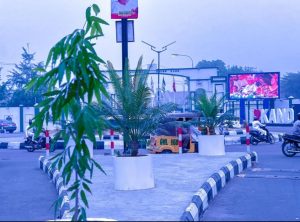
These projects are important because modern urban development requires coordinated investment in roads, drainage, water supply and environmental sanitation.
A road network without functional drainage, for instance, may deteriorate quickly, while inadequate water infrastructure can undermine the living conditions of residents.
Street lighting and the security of public spaces
Public lighting is another important component of urban development.
A properly illuminated city provides better visibility for motorists, pedestrians and other road users, while contributing to the security and attractiveness of public spaces.
The administration has included street lighting and solar-powered traffic management systems among its infrastructure interventions.
The installation of solar-powered traffic lights approved in April 2025 and the subsequent street-lighting initiatives are part of efforts to improve the functionality of the urban environment.
The government’s June 2026 approval for CCTV surveillance and security plazas around the Dan’agundi and Tal’udu flyovers further demonstrates the need to integrate security considerations into the planning and management of public infrastructure. Punch Newspapers +1
Infrastructure beyond Kano metropolis
While the transformation of Kano city attracts considerable public attention, the development agenda also extends to communities outside the state capital.
The Ministry of Works’ project registry identifies several ongoing road construction and rehabilitation projects across the 44 local government areas.
These include five-kilometre dual carriageway projects in Makoda, Rogo, Sumaila, Minjibir, Ajingi, Bagwai and Bunkure, among others.
There are also interventions involving bridges, culverts, erosion control and road rehabilitation.
Such projects are relevant to the state’s economic development because rural roads connect farmers to markets, facilitate the movement of agricultural produce and improve access to schools, hospitals and other essential services. Kano State Ministry of Works +1
For a state with a significant agricultural and commercial population, improving rural connectivity is as important as constructing modern infrastructure within the metropolitan area.
The financial commitment and project delivery
The scale of the administration’s infrastructure programme can also be understood through the financial figures presented by the government.
In July 2026, the Commissioner for Public Procurement, Projects Monitoring and Evaluation, Comrade Nura Ma’aji Sumaila, disclosed that the government had undertaken 1,508 development projects valued at over ₦928 billion, with 799 completed and 709 at different stages of implementation.
However, in a subsequent briefing reported by Punch on August 18, 2026, the commissioner presented an updated figure of 1,557 projects valued at approximately ₦996.29 billion.
Of the updated total, 867 projects were reported completed, while 654 were ongoing, with others at the award or planning stages.
These are government-reported figures covering multiple sectors, including education, healthcare, housing, rural development and infrastructure, rather than roads and bridges alone. Commissioner • Channels Television +1
The figures illustrate the scale of public investment being reported by the administration, although the ultimate measure of success will be the quality, durability, completion and actual impact of the projects on residents.
The road ahead: Making development sustainable
Despite the visible infrastructure interventions, Kano’s transformation into a modern metropolis requires sustained attention to several challenges.
First is the need to ensure that all ongoing projects are completed within agreed timelines and meet appropriate engineering standards.
Second is the maintenance of existing roads, bridges, drainage systems and public facilities. Infrastructure development should not end with commissioning; regular maintenance is necessary to protect public investment.
Third is the need for effective urban planning to accommodate the city’s expanding population. This includes proper land-use management, pedestrian walkways, parking facilities, drainage systems, public transport arrangements and accessible recreational spaces.
Environmental sustainability must also remain central to the urban renewal agenda. Tree planting, protection of green areas, waste management and the development of public gardens will help ensure that the growing metropolis remains healthy and environmentally friendly.
Equally important is transparency in project procurement, expenditure and implementation. Citizens deserve access to information about project costs, contractors, completion schedules and measurable results.
These are essential requirements for ensuring that infrastructural investments translate into lasting improvements in the lives of residents.
Conclusion: A city in transition
Kano today stands at an important point in its urban development journey.
The construction of interchange bridges, rehabilitation of metropolitan roads, expansion of road networks, pedestrian bridges, drainage systems, traffic management facilities and other public infrastructure initiatives represent a significant phase in the city’s modernisation efforts under Governor Abba Kabir Yusuf.
For a city whose commercial influence extends beyond Nigeria’s borders, modern infrastructure is not merely a matter of aesthetics. It is an economic necessity.
Efficient roads can reduce transportation difficulties, improve access to markets and encourage business activities. Functional drainage and water systems can improve public health, while properly designed recreational spaces can enhance the quality of urban life.
The ambition to reposition Kano as a modern city must therefore be accompanied by consistent planning, quality execution, accountability and sustainable maintenance.
Ultimately, the success of the urban renewal programme will not be measured only by the number of flyovers, kilometres of roads or projects commissioned, but by how much these investments improve the everyday experiences of the people.
From its historic commercial centre to its expanding metropolitan neighbourhoods and rural communities, Kano is undergoing a period of infrastructural change.
The challenge now is to sustain the momentum, complete ongoing projects and ensure that the emerging modern Kano is not only beautiful to behold but also functional, inclusive, economically productive and comfortable for generations to come.
Abdullahi Kano Writes From Kano .
namamaoga799@gmail.com
08035304623
 GOV. NASIR IDRIS TO INAUGURATE APC CAMPAIGN COUNCIL ON SUNDAY
 Akwa Ibom CP Commends Officers, Govt, Residents Over Successful Tinubu’s Visit
 Bandits Burn 13 Family Members to Death in Zamfara
 PCC receives 3,397 complaints in Kano in 9 months – Commissioner
 Jigawa Hisbah Board Strengthens Personnel Capacity Through Training, Community Engagement
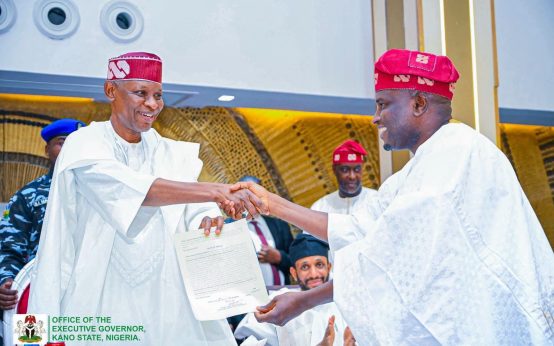 Sunusi Bature D-Tofa, Balarabe Gani Sworn In as Kano Commissioners
 GOV. NASIR IDRIS TO INAUGURATE APC CAMPAIGN COUNCIL ON SUNDAY
 Akwa Ibom CP Commends Officers, Govt, Residents Over Successful Tinubu’s Visit
 Bandits Burn 13 Family Members to Death in Zamfara
 PCC receives 3,397 complaints in Kano in 9 months – Commissioner
 Jigawa Hisbah Board Strengthens Personnel Capacity Through Training, Community Engagement
 Sunusi Bature D-Tofa, Balarabe Gani Sworn In as Kano Commissioners