
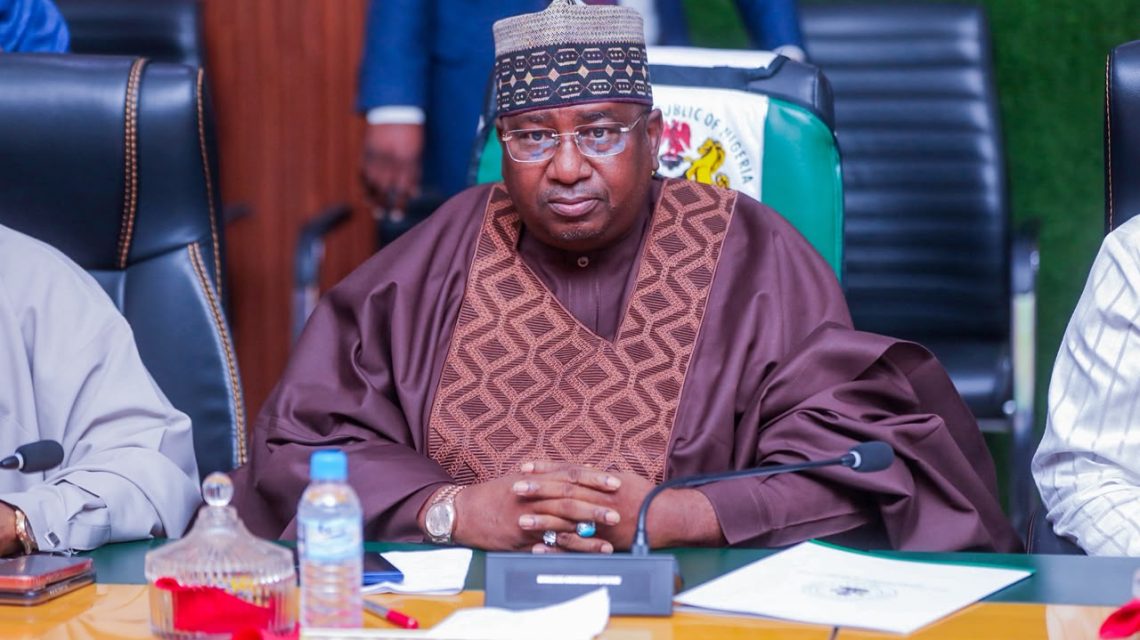
 Admin
By Ibrahim A. Jombali
Nigeria is in a democracy and like any other democratic nation, Nigerians are free to express their feelings on governance, criticise the leadership and rubbish achievements, no matter how beautiful. So, every day, you encounter new voices, paid columnists and career antagonists who will never see anything in a government if they do not support it, or like the face of the people in government. They go to every length to write lengthy and concocted stories of how a government has failed, what the government did not do right, what the government failed or refused to do, but will never say what the government has done, no matter how beautiful, no matter how positively such efforts have touched lives. They are sworn enemies of the people because it is not the government of their choice and style.
The easiest thing in politics is to pronounce a government a failure; but the more demanding task is to examine its record fairly, distinguish facts from interpretations, and allow evidence to speak beyond partisan expectations. Unfortunately, Usman Abdulkadir Taleeki’s article, “3 Months to Another Election Cycle, and Now Everybody Can Agree That Dr. Nasir Idris’s Tenure in Kebbi Is but a Total Failure,” appears to have reached its verdict before completing its investigation. It presents selected budgetary figures as conclusive proof of governmental failure while giving insufficient attention to the projects, policies, interventions and institutional changes that must form part of any serious assessment of governance. He deliberately avoided these pertinent issues because they were not what he was sponsored to talk about.
The title itself is revealing. The assertion that “everybody can agree” that Governor Nasir Idris has failed is not an established fact; it is a political opinion dressed up as a universal conclusion. Kebbi State is not a monolithic society in which every citizen thinks alike, and no commentator, regardless of academic credentials, political affiliation or confidence in his own arguments, possesses the authority to speak for everybody. Citizens assess governments through different experiences, priorities and expectations. Some examine budget documents, others assess roads, schools, hospitals, agricultural support, employment opportunities, security interventions and the responsiveness of government to their communities. A credible assessment must engage these realities rather than dismiss them because they complicate a predetermined narrative.
Taleeki is entitled to criticise Governor Nasir Idris. Indeed, public accountability is indispensable to democracy. However, criticism does not become more credible merely because it is lengthy, numerically presented or introduced with an elaborate warning about intellectual laziness. Numbers are important, but numbers must be interpreted correctly, placed in context and tested against observable outcomes. Otherwise, statistics can become instruments of selective persuasion rather than tools for public enlightenment.
The central weakness of this article is not that it raises questions about education, revenue generation and agriculture. These are legitimate matters for public debate. Its fundamental weakness is the attempt to elevate concerns about three sectors into a conclusive declaration that an entire administration has failed, without giving comparable attention to the wider record of governance in Kebbi State. They live in Abuja, dwell in Abuja, talk in Abuja and write about Kebbi even when they are practically away from it. Their mind is made up that Kebbi can never be good, not when their paymasters are not in charge.
A BUDGETARY PERCENTAGE IS NOT THE COMPLETE STORY OF EDUCATION
Taleeki’s principal but baseless argument against Governor Nasir Idris begins with education. He cites a decline in the proportion of the state budget allocated to education, from 28.65 per cent in the final year of the previous administration to 14.96 per cent and subsequently 12.01 per cent. He then interprets these figures as evidence that a former teacher has neglected the sector he once served.
At first glance, the argument appears interesting . However, a closer examination reveals an important distinction: the percentage of a budget allocated to a sector is not, by itself, a complete measure of the resources committed to that sector, the quality of implementation or the outcomes achieved.
A responsible analysis must examine the total size of each annual budget, the actual amount appropriated for education, the releases made during the year, expenditure on capital and recurrent activities, and the projects delivered. It must also establish whether the figures being compared cover the same categories of expenditure and are based on consistent accounting methods.
If the percentage allocated to education declined, the next question should be whether the nominal allocation also declined, by how much, and what happened to actual expenditure and educational outcomes. Without that additional analysis, the percentage alone cannot establish the full extent of the government’s commitment or the degree of its success or failure. A mind deeply secluded from reality and beclouded by partisan considerations is naturally deprived of objective analysis and fair judgement.
This is not an argument against scrutiny. It is an argument for better and objective scrutiny.
The international benchmark invoked by Taleeki also deserves careful treatment. The widely cited education-financing benchmark is a useful policy reference, but it should not be presented as a substitute for examining the actual financial and operational record of a state government. The relevant question is not merely whether an allocation crosses a particular percentage threshold; it is also whether the money appropriated is spent effectively and whether children, teachers and schools benefit from it. The writer took a hurried flight from this because it does not serve his planned purpose.
More importantly, an assessment of education under Governor Nasir Idris cannot reasonably end with a budgetary table while ignoring interventions in school infrastructure, teaching resources and the administration of basic education.
Taleek has claimed ignorance of the fact that the administration has pursued school construction, renovation and furnishing initiatives, alongside the distribution of Android phones to head teachers in 2,014 primary schools and the provision of more than 4,000 tablets for educational purposes. The government has also committed substantial resources to school furniture, with a reported allocation of ₦7.2 billion.
These interventions deserve independent verification and a proper assessment of their results. How many schools have benefited? What condition were the facilities in before the interventions? How have the digital devices been deployed? What improvements have occurred in teaching, learning and school management? These are the questions that a serious education review should investigate.
What cannot be justified is to treat budget percentages as the entire story while giving insufficient attention to the practical interventions that have taken place.
The welfare of teachers must equally be assessed fairly. Kebbi State’s minimum wage was raised to ₦75,000, a development relevant to public-sector workers, including teachers. The administration has also pursued measures affecting teachers’ service conditions. Such policies do not automatically settle every question about salaries, recruitment, training or working conditions, but neither can they simply be ignored when evaluating the administration’s record.
If there are shortcomings in classroom infrastructure, teacher deployment, learning outcomes or budget execution, let them be identified and documented. If additional reforms are necessary, let them be proposed. But a balanced assessment must acknowledge both the work undertaken and the challenges that remain.
A former teacher who becomes governor should be judged by the totality of his educational policies and their measurable outcomes, not condemned through a single line of budgetary comparison.
THE ECONOMY: FEDERAL ALLOCATIONS ARE NOT, IN THEMSELVES, EVIDENCE OF FAILURE
Taleeki next argues that Kebbi State remains excessively dependent on federal allocations, grants and borrowing, and that the government has failed to generate internally even five per cent of its projected annual budget in the years he examined.
The question of internally generated revenue is legitimate. Every state should seek to improve revenue collection, broaden its economic base, encourage investment and reduce avoidable dependence on external transfers.
However, the argument becomes unfortunately misleading when dependence on Federation Account Allocation Committee receipts is treated almost as an admission of incompetence.
Nigeria operates a federal fiscal system in which states receive statutory allocations from centrally collected revenues. These transfers are a normal and constitutionally established component of state financing. Their receipt is not a favour from the Federal Government, nor does it automatically indicate that a state government has failed.
The real question is how responsibly and productively those resources are used.
A state can receive substantial federal allocations and still fail its citizens through waste, poor planning and abandoned projects. Equally, a state can have relatively modest internally generated revenue while making meaningful investments in infrastructure, public services and human development. The distinction lies in fiscal management, expenditure quality, economic conditions and measurable outcomes.
The comparison between internally generated revenue and a state’s total projected budget also requires context. A low IGR-to-budget ratio indicates a revenue challenge, but it does not, on its own, establish that the government has failed in every other area. To reach that conclusion, one must examine revenue trends, collection efficiency, the structure of the local economy, the state’s tax base, non-tax revenues, transfers received and the measures introduced to expand economic activity.
The writer himself acknowledges that borrowing is not inherently wrong. That concession is important. Loans can be legitimate instruments of development when they are transparently obtained, responsibly managed and directed towards productive investments. What matters is the purpose of the borrowing, the terms, the repayment implications, the projects financed and the benefits delivered.
The appropriate test is therefore straightforward: What resources were available? What was spent? What assets and services were delivered? What liabilities were incurred? What benefits will citizens receive, and can the state sustain its obligations?
These questions require evidence, not rhetorical shortcuts.
Governor Nasir Idris should be held accountable for improving Kebbi’s economic foundations, but his administration should not be judged as though federal transfers are illegitimate or as though internally generated revenue is the sole indicator of governmental performance.
AGRICULTURE: FERTILISER DISTRIBUTION IS NOT THE ENTIRE AGRICULTURAL POLICY
Taleeki’s agricultural argument follows a similar pattern. He cites the reported allocation of approximately 17.8 per cent of the 2025 budget to agriculture and questions whether the spending has produced commensurate results. He then focuses on the composition of fertiliser distribution committees and suggests that the involvement of political representatives raises concerns about partisan influence.
There is a legitimate principle at stake here: agricultural support financed with public funds must be administered fairly, transparently and according to clearly defined criteria.
But allegations of possible political influence must be supported by evidence of how the programme actually operated. The presence of political officeholders on a committee does not, by itself, establish that fertiliser was distributed unfairly, that non-APC farmers were excluded or that the programme failed. Those are questions that require beneficiary records, distribution criteria, procurement documentation, field verification and evidence of actual outcomes.
If there are specific cases of diversion, favouritism or exclusion, they should be documented and investigated. If the distribution system requires reform, recommendations should be made to improve transparency and ensure that assistance reaches the right beneficiaries. What should be avoided is turning a concern about committee composition into an established finding of misconduct without demonstrating what occurred.
There is also a wider problem with reducing agricultural development to the distribution of fertiliser. Fertiliser is an important input, particularly in a state where agriculture sustains numerous households and contributes significantly to food production. Yet agricultural transformation involves much more: access to quality seeds, irrigation, mechanisation, extension services, storage, processing, rural roads, markets, credit and protection against production risks.
The government should be assessed against this broader range of responsibilities.
Kebbi’s agricultural potential is too important to be reduced to a partisan exchange over committee membership. The state has established policies that help farmers produce more, reduce post-harvest losses, connect rural communities to markets and improve the value farmers receive for their labour.
In July 2026, Channels Television reported that Kebbi commenced the distribution of 110 truckloads of fertiliser and 100 metric tonnes of improved seeds, with approximately 120,000 farmers expected to benefit. The report also identified interventions involving farm implements, subsidised tractor-hiring services and irrigation pumps.
The interventions are reaching the intended beneficiaries, the inputs arrive in time for planting, the distribution is equitable, and farmers are recording improvements in production and income.
Taleeki demands evidence of transformation. That is a reasonable standard, but it must be applied consistently. He cannot demand that the government substantiate its achievements while treating his own suspicions about political influence as though they were conclusive findings.
GOVERNANCE MUST BE MEASURED BY THE TOTALITY OF ITS RECORD
The most significant flaw in Taleeki’s article is the gap between the evidence he presents and the sweeping conclusion he reaches.
His discussion focuses principally on three sectors: education, the economy and agriculture. Yet his title pronounces the entire tenure a total failure. Where is the comprehensive assessment of infrastructure? Where is the detailed evaluation of road construction, healthcare, workers’ welfare, rural development, public infrastructure and security interventions? Where is the balanced comparison between inherited conditions, available resources, projects completed and challenges that remain?
A government does not operate through a single ministry, and its performance cannot be reduced to three selected indicators.
Under Governor Nasir Idris, Kebbi has pursued infrastructure projects intended to improve connectivity between communities and economic centres. Rural road interventions, including the Dukku–Tarasa road project, illustrate the administration’s stated effort to address longstanding transport difficulties affecting communities. Projects linking rural settlements can have consequences for access to markets, the movement of farm produce and the ability of residents to reach essential services.
Such projects should be evaluated through contract records, construction progress, completion status, engineering quality, costs and actual benefits to users. They should not be dismissed merely because a commentator has chosen to focus on another sector.
Workers’ welfare also belongs in the assessment. The administration’s ₦75,000 state minimum wage is a relevant policy measure. Its reported payments exceeding ₦10 billion towards gratuities, death benefits and outstanding entitlements, alongside a reported ₦2.11 billion disbursement benefiting 772 retirees and bereaved families, are also matters that deserve verification and consideration in any balanced appraisal of public administration.
These figures should not be accepted uncritically simply because they support the government, just as figures critical of the administration should not be accepted without examining their sources, definitions and context. The same standard of verification must apply to both sides.
That is what distinguishes a credible public assessment from an orchestrated political propaganda.
No responsible observer should claim that these interventions automatically establish that the administration has succeeded in every respect. Kebbi continues to face significant developmental challenges, and citizens are entitled to demand better services, stronger institutions and greater economic opportunities. But acknowledging challenges is not the same as declaring that nothing has been achieved.
The intellectually honest position is to examine the record sector by sector, identify successes and shortcomings, and determine whether the administration is moving the state forward. That process may produce criticism, praise or a mixture of both. What it cannot reasonably produce is a credible verdict of total failure based on an incomplete assessment.
THE POLITICS BEHIND THE VERDICT
Taleeki identifies himself as a member of the ADC Kebbi Gubernatorial Campaign Team’s strategic media and policy directorate. That affiliation does not invalidate his arguments. Political actors are entitled to criticise the government, and opposition participation is an essential feature of democratic accountability.
However, the disclosure of that affiliation makes it even more important to distinguish political advocacy from an independent, honest and credible performance audit.
A campaign team has a legitimate interest in orchestrating weaknesses in an incumbent administration and presenting an alternative political vision. But a political article should not be mistaken for a comprehensive, impartial evaluation simply because it contains percentages, budget figures and references to earlier publications.
It is naturally expected that the opposition will always shout that Governor Nasir Idris has failed. What it has unfortunately and deliberately failed to do is to demonstrate not only what it considers wrong with his administration but also what it would do differently. How would it improve education financing and learning outcomes? How would it strengthen internally generated revenue without placing an unfair burden on ordinary citizens and small businesses? How would it improve agricultural productivity, ensure transparent distribution of inputs and expand rural infrastructure? What measurable targets would it establish, and how would the public assess its performance?
These are the questions that transform opposition criticism into a credible alternative programme.
It is not enough to identify a problem. A serious political alternative must explain how it intends to solve that problem, what resources it would require, what trade-offs it would involve and how success would be measured.
The people of Kebbi deserve more than a succession of declarations that the incumbent has failed. They deserve a contest of ideas, evidence and practical solutions.
THREE MONTHS TO AN ELECTION CYCLE AND THE OPPOSITION’S FEAR OF SERIOUS DEFEAT.
The article’s reference to the proximity of another election cycle is politically significant. It invites readers to view the administration’s record through the lens of an approaching electoral contest. It also exposes the palpable fear of defeat living in the heart of the opposition, ADC.
Let me say that an approaching election does not make an allegation true, just as a political slogan does not become evidence merely through repetition.
Elections should be occasions for citizens to examine competing records and proposals. The governing party must answer questions about its performance, while the opposition must demonstrate the credibility of its criticisms and the viability of its alternatives. Neither side should expect immunity from scrutiny.
Governor Nasir Idris should not be shielded from legitimate criticism because he belongs to the APC. Equally, he should not be condemned through a sweeping verdict that overlooks relevant evidence, excludes major areas of governance or confuses shortcomings in particular sectors with total governmental collapse.
The proper question is not whether every promise has been fulfilled or whether every policy has produced the desired result. No government can credibly claim perfection. The proper question is whether the administration’s record, examined against its responsibilities, resources, commitments and measurable outcomes, justifies the conclusion being advanced.
Taleeki has presented arguments that warrant examination. He has not, through the evidence reproduced in his article, established that the entire tenure is a total failure. He has raised questions about budget priorities, revenue generation and agricultural spending, but questions are not verdicts, suspicions are not findings, and selected statistics are not a substitute for a comprehensive assessment of governance.
THE QUESTION IS NOT WHETHER KEBBI HAS CHALLENGES, BUT WHETHER THE GOVERNMENT IS ADDRESSING THEM
Nobody needs to pretend that Kebbi State has solved every developmental problem. The state will continue to improve on critical sectors and citizens are right to demand progress in all these areas.
However, acknowledging outstanding challenges does not require us to deny every achievement. A government may make substantial progress in infrastructure while struggling with revenue generation; it may improve school facilities while needing to strengthen learning outcomes; it may distribute agricultural inputs while still needing better systems for measuring productivity.
Taleeki and his Abuja bosses know that governance is complex, and honest evaluation must reflect that complexity. He covered the reality because he has a mission: the administration must be attacked by whatever means.
In assessing Governor Nasir Idris, therefore, the relevant questions include what conditions his administration inherited, what resources became available, what policies were introduced, what projects were delivered, what measurable changes occurred and which problems remain unresolved.
The official budget and implementation documents published by the Kebbi State Government provide a basis for examining appropriations and expenditure. Those records should be compared with project documentation, independently verified field evidence and relevant service-delivery indicators.
That approach would enable citizens to distinguish between expenditure that produced tangible benefits and expenditure that failed to deliver its intended purpose. It would also reveal where government claims require correction or further substantiation.
The public deserves that level of rigour, not an argument in which figures are selected to support one political conclusion while contrary or complicating evidence receives little attention.
AN OPPOSITION CAMPAIGN MUST OFFER MORE THAN A VERDICT
Taleeki’s political affiliation is relevant to understanding the context of his article, although it does not invalidate his right to criticise the government. The ADC and other opposition groups have every right to scrutinise Governor Nasir Idris and present alternative proposals to the people of Kebbi.
But a credible opposition must do more than catalogue perceived failures. It must explain how it would improve the situation.
If the ADC believes education financing is inadequate, what funding model would it adopt, and how would it protect spending on teachers, classrooms and learning materials? If it believes the state’s internally generated revenue is too low, what practical reforms would it introduce without imposing unreasonable burdens on citizens and small businesses? If it considers agricultural spending ineffective, what alternative programmes would it implement, how would beneficiaries be selected, and what targets would it set for productivity and farmers’ incomes?
These are not unreasonable demands. They are the minimum questions citizens should ask any political organisation seeking the responsibility of governing a state.
It is easy to write that a government has failed. It is more difficult to design a realistic programme, identify the resources required, establish measurable targets and accept responsibility for the results.
The opposition must demonstrate that it can do the latter.
THE FINAL VERDICT BELONGS TO THE PEOPLE
As Kebbi State approaches another electoral cycle, political arguments will inevitably become sharper. The APC should welcome legitimate scrutiny, respond to substantiated criticism and remain accountable for the decisions of its government. It should also communicate its record with verifiable evidence rather than assume that every policy has succeeded simply because it was announced.
At the same time, the opposition must recognise that criticism is most persuasive when it is fair, comprehensive and supported by evidence. Political ambition cannot substitute for an independent assessment, and repetition cannot turn an allegation into an established fact.
Governor Nasir Idris should be judged by his actual record, including the projects completed, the services delivered, the resources managed, the challenges encountered and the commitments yet to be fulfilled. That assessment should be open to scrutiny and should not be reduced to the political preferences of either his supporters or his opponents.
The question is not whether the administration deserves criticism. Every government does. The question is whether the criticism accurately reflects the full record and whether the proposed alternative offers a credible path forward.
Taleeki’s article raises issues worth examining, but its sweeping declaration of total failure goes beyond what the three sectors discussed can conclusively establish. A budgetary percentage cannot independently determine the quality of an education system; dependence on federal allocations cannot, on its own, establish the failure of an entire economy; and questions about fertiliser committees cannot prove that an agricultural programme has failed without evidence of its actual operation and outcomes.
Facts are stubborn things, and they must be applied consistently.
The government of Dr Nasir Idris has demonstrated its capacity by the successes it has so far recorded in various sectors. claims success,. If the opposition out of the desperation to grab power by hook or crook, alleges failure, let it substantiate the allegation.
That is how democracy becomes stronger: not through the loudest accusation, the longest article or the most confident political declaration, but through facts, accountability and a willingness to examine the evidence fairly.
Governor Nasir Idris is not entitled to an unquestioning endorsement, but neither should he be subjected to an unquestioning condemnation. His achievements must be assessed on their merits.
Ultimately, the people of Kebbi State deserve a debate that goes beyond political labels and sweeping verdicts. They deserve evidence of what has worked, honesty about what has not, and practical proposals for what must happen next.
A verdict of total failure must be demonstrated, not merely declared. Governor Nasir Idris is completely focused and committed to the continued transformation of Kebbi. No opposition can be happy or comfortable with the giant strides of the Kaura administration. No wonder that the people of Kebbi state continue to celebrate the achievements and increasing the pain in the hearts of those opposed to the progress and development of Kebbi state. No doubt, three months is so close and the people of Kebbi state will show where the belong; reality and not propaganda, Kauran Gwandu and not deceitful noise makers.
Ibrahim Abubakar Jombali
Special Adviser on Public Enlightenment and Orientation to the Executive Governor of Kebbi State
 Group Prays for Quick Recovery of Abdulsalam, Senator Musa
 Self Help Africa Sensitises Kano Community on Safe Drinking Water
 Kaduna-Kano-Maradi Rail Line: FG Targets December Train Operations
 Troops Rescue Kidnap Victim, Recover N10m Ransom in Kano
 WHC Solar trains nearly 300 installers to improve solar services in Nigeria
 Gov. Yusuf Celebrates Senator Basheer Lado at 60
 Group Prays for Quick Recovery of Abdulsalam, Senator Musa
 Self Help Africa Sensitises Kano Community on Safe Drinking Water
 Kaduna-Kano-Maradi Rail Line: FG Targets December Train Operations
 Troops Rescue Kidnap Victim, Recover N10m Ransom in Kano
 WHC Solar trains nearly 300 installers to improve solar services in Nigeria
 Gov. Yusuf Celebrates Senator Basheer Lado at 60