

 Admin
Admin
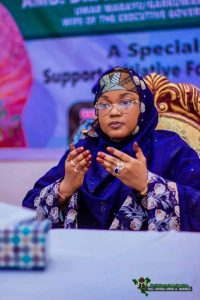
In a society where economic hardship continues to pose challenges for many families, the Wife of the Jigawa State Governor, Hajiya Dr. Amina Umar Namadi, has emerged as a beacon of hope for widows, orphans and vulnerable women across the state.
Driven by a deep sense of compassion and commitment to humanitarian service, Dr. Namadi has dedicated much of her efforts to improving the living conditions of society’s most disadvantaged groups. Her interventions, which cut across women empowerment, support for widows and care for orphans, have continued to touch lives in communities throughout Jigawa State.

Speaking during a recent interview with DCL Hausa at the Government House in Dutse, the First Lady attributed her passion for helping the less privileged to the moral upbringing and parental guidance she received during her formative years. According to her, the values of kindness, empathy and service to humanity instilled in her by her parents laid the foundation for her lifelong commitment to supporting those in need.
“The training and guidance I received from my parents at an early stage of my life taught me the importance of caring for others, especially those facing difficult circumstances,” she said. “That upbringing shaped my outlook and inspired me to dedicate my time and resources to assisting widows, orphans and vulnerable members of society.”

One of the most notable initiatives championed by Dr. Namadi is the sponsorship of mass weddings for eligible young men and women across Jigawa State. The programme, which has attracted widespread commendation, was designed to address the growing challenges many youths face in fulfilling their dreams of marriage due to financial constraints.
Explaining the rationale behind the initiative, Dr. Namadi revealed that she had received numerous complaints from young people and their families about the difficulties associated with marriage arrangements. She noted that many intended couples had repeatedly postponed their weddings because of rising costs and economic pressures.
“I encountered many cases where young men and women genuinely wanted to get married but could not afford the expenses involved,” she explained. “Some had postponed their weddings several times because of financial challenges. It became clear that intervention was necessary to help them establish stable family lives and contribute positively to society.”
The mass wedding programme, according to observers, has not only eased the burden on families but has also strengthened social cohesion by providing a dignified pathway to marriage for many young people. Beneficiaries have described the initiative as life-changing, enabling them to begin new chapters of their lives with renewed hope and confidence.

Beyond marriage support, women empowerment remains a central pillar of Dr. Namadi’s development agenda. Recognising the crucial role women play in family welfare and community development, she has implemented programmes aimed at equipping women, particularly widows and rural dwellers, with practical skills and economic opportunities.
Under her empowerment initiatives, women from remote villages and hamlets across the state are carefully screened and selected for vocational training in various trades. Upon completion of the training, beneficiaries receive starter packs and financial support to establish small businesses and become self-reliant.
Dr. Namadi believes that empowering women creates a ripple effect that benefits entire communities. “When you empower a woman, you empower a family, and when families are empowered, communities become stronger,” she said. “Our goal is to ensure that women can contribute meaningfully to economic development and provide better futures for their children.”
Development experts have long acknowledged the link between women empowerment and sustainable development, noting that women who are economically independent are better positioned to support education, healthcare and nutrition within their households. Dr. Namadi’s programmes align with these principles and reflect a broader commitment to inclusive growth and social welfare.
Her advocacy for widows and orphans has also earned her recognition from various groups and stakeholders. Through targeted interventions, charitable outreach programmes and partnerships with community organisations, she has sought to alleviate the challenges faced by vulnerable households while promoting social inclusion.
As Jigawa State continues to pursue its development objectives, Dr. Amina Umar Namadi’s humanitarian initiatives stand out as a testament to the transformative power of compassion-driven leadership. Her efforts have not only provided immediate relief to thousands of beneficiaries but have also created pathways for long-term economic empowerment and social stability.
For many widows, orphans and young couples whose lives have been positively impacted by her interventions, the First Lady’s commitment represents more than charity—it symbolizes hope, opportunity and the promise of a brighter future. Through her unwavering dedication to humanitarian service, Dr. Namadi continues to demonstrate that leadership is most impactful when it uplifts the most vulnerable members of society.
Written by Abdullahi Kabir
can be reached via email…namamaoga799@mail.com
 On the Relaunch of FreeTV in Abuja and a Word of Caution to Investors
  Sky Construction Boss Felicitates Muslims on Islamic New Year 1448 AH
  How DSP Barau’s Explosives Bill SB.70 Targets Illegal Mining Amid Gold Seizure at MAKIA
  Abdulsalami Abubakar: The peacemaker who guided Nigeria back to democracy
  The Forgotten Guardian: Tragedy, Sacrifice and the Struggle of a Kano Vigilante Commander
  Ambassador Dr Amina Umar Namadi Felicitates Residents on Democracy Day, Calls for Unity and Peace
  Sokoto car dealers pledge support for APC, Wamakko promises intervention
  PTA Commends Dawakin Tofa Chairman for Securing School Site, Building Classrooms in Dawanau.
  APC’s Shuaibu Wins Dawakin Kudu/Warawa Federal Constituency By-Election
  Umar Namadi’s Transformative Legacy: A Governor Redefining Development in Jigawa State
  Governor Radda Warns Against Diversion of 100,800 Bags of Fertilizer Under Renewed Hope FISP
  Former Head of State Calls for National Unity to Tackle Insecurity in Nigeria