
 Admin
Admin
By Adamu Aminu.
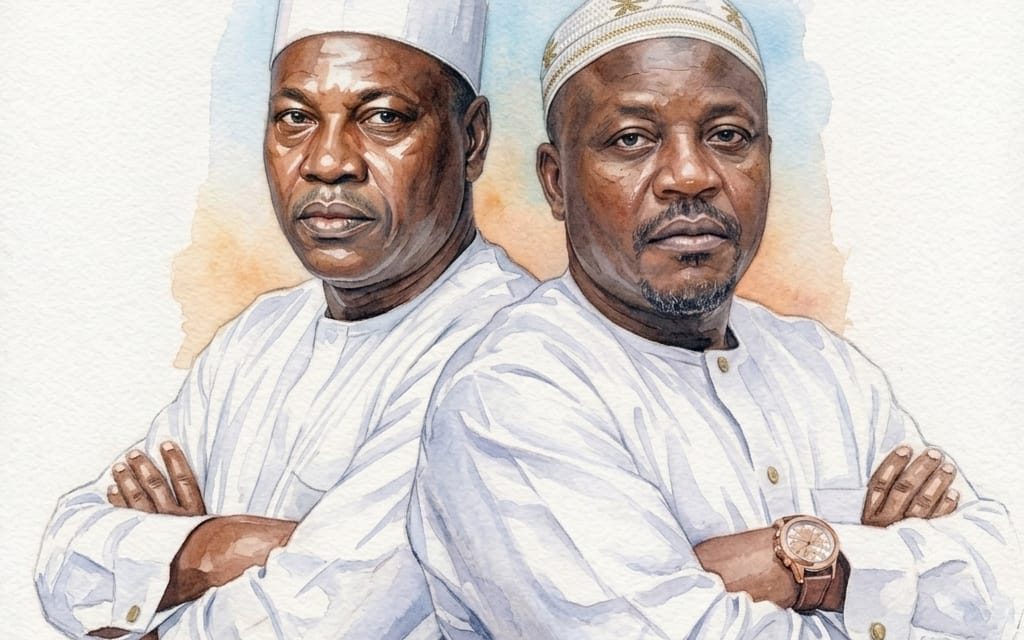
The political dynamic in Kano South has shifted from collaboration to confrontation. Hon. Kabiru Alhassan Rurum and Senator Kawu Sumaila, once viewed as allies with aligned ambitions, now stand on opposite sides of a widening political divide.
For years, the two were regarded as political kindred spirits, moving in concert across local and state platforms. That association has cooled, and the relationship appears to have fractured.
The precise reasons remain known only to the principals involved, but the public consequences are becoming evident in party structures and grassroots networks.
The rupture is more than a personal disagreement. It has emerged as a notable feature of the region’s political climate, with potential implications for party cohesion, mobilization capacity, and the distribution of influence across Kano South.
In a public gathering in Rano on Saturday, held during an affirmation event with supporters and party loyalists, Rurum’s remarks indicated a deliberate decision to set a boundary with his former associate.
Neither Rurum nor Senator Sumaila has issued a formal, detailed statement outlining the terms of the break. However, the trajectory of public engagements and mobilization efforts suggests that reconciliation is not imminent.
The use of the term “red line” conveys a boundary that is not to be crossed, a point beyond which the relationship cannot revert to its previous state.
Political analysts describe the move as both symbolic and strategic. On one hand, it signals Rurum’s intent to assert political independence and to define the limits of future cooperation. On the other, it raises questions about the trade-offs involved.
A firm stance may consolidate his base and clarify his political identity. It may also risk narrowing his scope for alliance-building within the broader party structure in Kano South and at the state level.
For Senator Sumaila, the development marks a shift in his political positioning within the zone. Previously regarded as a partner in shaping Southern Kano’s direction, he now finds himself excluded from Rurum’s immediate circle. Supporters of the senator characterize the red line as an act of hostility. Critics counter that it reflects the inevitable outcome of divergent ambitions in a competitive political environment.
The effects are already visible at the grassroots. Party members, ward leaders, and community stakeholders are reassessing affiliations and recalculating interests.
In a zone where alliances often determine electoral outcomes, such a split introduces uncertainty. It threatens to fragment APC support structures, weaken coordinated strategy, and create openings for rival parties and factions to expand influence.
This context reflects a recurring pattern in Nigerian politics: relationships formed in pursuit of shared goals can unravel under the pressure of individual ambition and shifting calculations. The Rurum–Sumaila fallout is not isolated, but it is illustrative. It shows how bonds once presented as solidarity can become sites of contestation when interests diverge.
The red line drawn in Kano South is therefore more than rhetorical. It is a marker of changing alignments, contested loyalty, and the pragmatic realities of political competition.
Whether it strengthens both actors by clarifying their positions or weakens the party’s hold in the zone will depend on how the split is managed in the months ahead.
If the boundary is rooted in political calculation rather than irreconcilable differences, can either actor afford to keep it in place beyond the next electoral cycle without damaging the party’s collective prospects in Kano South?
Adamu Aminu writes from Kano.
 When Ja’o’ji Answers Reconciliation With Humility in Victory
  APC Aspirant Raises Concerns Over Conduct of Primary Election in Jigawa Constituency
  Kano Govt Pledges Stronger Collaboration with FG, Partners on Education
  Ambassador Dr Amina Umar Namadi Sponsors Mass Marriage for 300 Couples in Jigawa
  Police Warn Against Violence Ahead of APC Primaries in Akwa Ibom
  RFI Hausa to Host Festival, Celebrate Kannywood in Kano
  When Ja’o’ji Answers Reconciliation With Humility in Victory
  APC Aspirant Raises Concerns Over Conduct of Primary Election in Jigawa Constituency
  Kano Govt Pledges Stronger Collaboration with FG, Partners on Education
  Ambassador Dr Amina Umar Namadi Sponsors Mass Marriage for 300 Couples in Jigawa
  Police Warn Against Violence Ahead of APC Primaries in Akwa Ibom
  RFI Hausa to Host Festival, Celebrate Kannywood in Kano