
 Admin
Admin By Abba Anwar
It is evidently clear and on record to understand that Kano thirsty decade is ending, as how His Excellency the Governor of Kano State, Eng Abba Kabir Yusuf is turning 95 years of ruin into a N21.3 Billion revival. This is leadership, commitment, display of patriotic political will and understanding of complexities and peculiarities of human existence.
What Kano is experiencing now, in terms of redirecting the water industry into human face, calls for global gist and account. For example in Cape Town, they called perennial shortage of water Day Zero – the day the taps would run dry.
In Flint, Michigan, history tells us that it was a lead poisoning crisis that shocked America. While in Kano, Africa’s most populous city, situated in Northern Nigeria, it was slower, quieter, and more painful. Very pathetic and heartbreaking, for over ten years, the taps simply stopped. No announcement. No Day Zero. Just air.
The history of Kano water sector reveals that the city needs 700 million litres of water every single day to survive. Until last year, it was getting less than 300 million. A deficit of 400 million litres. That is not a shortage; it is a systemic collapse. Mothers woke up at 4 a.m. to queue at boreholes. Children trekked kilometres with jerry cans. Industries shut down. Cholera whispered in the background.
Identification of problem didn’t match with problem diagnosis. For years, successive administrations applied plaster to a cancer. The current administration of Governor Yusuf has chosen to perform open-heart surgery. A better and neater option. Surgical operation not plaster application. Which catches and punches the right button.
And the heart is now beating again as the Governor means business and genuine service delivery.
Kano’s 95-year-old legacy, which I term as The Soul of a City, is a deliberate presentation for proper
understanding of the magnitude of what is happening now. Hence we must understand what was lost.
Kano’s water story did not start yesterday. It started in 1927, when the British colonial administration, under Emir Abdullahi Bayero, broke ground for what would become the first waterworks in Northern Nigeria – the Challawa Water Works. Completed in 1930, with a modest 20 million litres per day, it was an engineering marvel of its time. It supplied Dorayi, Kabuga, Kofar Fanfo, Jan Bulo, Rijiyar Zaki, and even the Army Barracks in Janguza. It ran non-stop for 86 years.
Then came its younger brothers. The Old Tamburawa in 1986 – 9.6 million litres, later upgraded to 20 million. Then the New Tamburawa, a behemoth with a 150 million litre per day capacity. And anchoring them all, the legendary Goron Dutse reservoirs – five massive underground and surface reservoirs built between 1930 and 1974, with a combined storage of over 40 million litres. They were the lungs of Kano’s distribution.
By whatever standard and estimation this was a system built by visionaries, with clearly defined vision. But it was, unfortunately, killed by neglect. Year in year out all the donkey years witnessed terrifying reality when city’s lifeline was utterly and irresponsibly looted.
To tell my reader that, that experience was worrying our Governor deeply even before he came on board, before he took the oath of office on May 29, 2023, he set up a powerful Committee of Experts to look into the perennial nature of the water industry. Immediately after he came on board his engineers gave him a report on water that read like a war zone assessment.
Since then, when I discussed the concern with a friend from Darmanawa he quickly commended the effort and called for public support of the entire process and procedures.
It was fundamentally clear that in Challawa, the scene was “pathetic and disheartening,” in the official words of the Ministry. Out of six giant industrial generating sets that power the entire plant when the national grid fails, only two were limping. Water Works No. 1 and No. 2 were dead. No. 3 was gasping at 30% capacity. A call for action at whatever rate.
Worse than decay was destruction. Raw water pumps were gone. Electrical starters ripped from control rooms. Underground electrical facilities stolen. And in an act that shocked even veteran engineers, a 15-kilometre, 15.6 kilometre underground transmission pipeline – the artery that feeds Challawa – was excavated and stolen. Not vandalised. Stolen. Some individuals even walked into the premises claiming the federal government had sold the waterworks to them. A brazen dishonesty of the highest order.
At Goron Dutse, the story was even more symbolic. The reservoirs that had quenched Kano for nearly a century had not received a single drop of water for over ten years. Ten years! They were dry, cracked, and filled with silt. As bad as economies during conventional wars. Abandonment amid need for attention.
The total cost of decay was put at over N30 billion. An administration in the past had spent N5.6 billion in just 11 months for “maintenance” but it was maintenance without a soul. As pipes were not replaced, reservoirs were not desilted, pumps were not procured. The result? Tamburawa, designed for 150 million litres, was doing 27%. Challawa, designed for 220 million, was doing less than 30%. Together, they should produce 370 million litres. They were producing less than 90 million.
To revive just Challawa, an official told journalists that the state would need $3.5 million, later revised to over $10 million, because the 1930-era machines have to be custom-built in Europe on demand. They are not on any shelf in the world.
This is the rot Governor Yusuf inherited. To me, Governor Yusuf’s political will is doctrinal with no match in sight. Unmatched political will. It is glaring for all to know that great cities are not revived by press releases. They are revived by political will. This is where His Excellency separates himself from every administration in the last decade.
He did not send a committee. He went himself. Since from the start of the good re-engineering touch of the water facilities. For example just yesterday, he and his able Deputy H.E. Murtala Sule Garo alongside other top government functionaries visited water projects that are almost ready for good operations.
In a now-famous inspection tour, Governor Yusuf, in rain boots, walked the length of Challawa and Tamburawa with engineers from CGC Nigeria Limited and CCECC Nigeria Limited – the same Chinese engineering giants building Africa’s biggest dams and railways. He saw the leaking pipes. He saw the obsolete clarifiers. He saw the dead high-lift pumps. And there, on the spot, he made a decision that will define his legacy.
He approved without any hesitation, the sum of N21.29 billion. Wow! the single largest water investment in Kano in 15 years. Leadership by example. Viva our dear Governor Viva.
Not N21.89 billion in rumour. N21.29 billion in signed contracts. With N9.9 billion to CGC Nigeria Limited for the total rehabilitation of Tamburawa Water Treatment Plant and its raw water pump station. The sum of N11.39 billion to CCECC Nigeria Limited for the rehabilitation of Challawa Raw Water Pump Station, its treatment plant, and the total restoration of the Goron Dutse reservoirs. Action! Action!! Action!!!
This is not rehabilitation on paper. This is what is happening on the ground right now, as confirmed by Dr. Dahiru Muhammad Hashim, Acting Commissioner for Water Resources, Environment and Climate Change. That:
1. The critical 15.6-kilometre transmission line to Goron Dutse has been restored with modern ductile steel pipes, replacing the 1970s asbestos pipes that were poisoning the system.
2. Goron Dutse reservoirs have been fully desilted and repaired.
3. Clarifiers, filtration units, manifolds, and high-lift pumps have been restored.
4. Ten high-capacity 110-kilowatt pumps have been procured.
5. A full test run was completed in mid-September.
And beyond the metropolis, the Governor is doing what no one did – reviving the dead. Nine out of Kano’s 19 dormant regional water schemes are under restoration. Guzugu in Kabo is flowing. Joda in Gabasawa is flowing. Wudil Waterworks, dead for years, is alive. For the first time, rural Kano is part of the water equation. Government for all sections of the state.
On September 21, 2026, the Ministry officially announced: expanded distribution of potable water would commence within few days to come. All are waiting patiently Your Excellency Sir!
Why Kano must attract global communities? From London to Lagos, water is politics. The UN says water scarcity will displace 700 million people by 2030. What Governor Yusuf has done is a case study in how to reverse it without World Bank loans, without privatising your heritage.
He did not outsource the problem. He funded the solution. He did not blame the past. He fixed the future. Sometime in the past I spoke to Malam Musa in Tarauni, he was lamenting all over. When asked again, now, he simply smiles that Governor Yusuf is on the top of the situation. This is courageous.
When the taps in Kofar Mata sputter and then gush, when a child in Dala drinks from the tap for the first time in his life, when Goron Dutse reservoirs hold water again after a 10-year drought, Kano will not just be celebrating water. Kano will be celebrating a Governor who proved that a 95-year-old dream, buried under silt, stolen pipes, and failed promises, can still flow.
That is not just governance. That is unmatched and unwavering political will in action.
KANO FLOWS AGAIN UNDER GOVERNOR YUSUF!
Viva Kano. Viva Abba Gida-Gida.
Anwar writes from Kano
Tuesday, 29th September, 2026
 Murtala Muhammad Library Complex as Northwest University Kano Campus: A Decision Worth Applauding
  Kano’s NECO Success: What Sustained Investment in Education Is Producing
 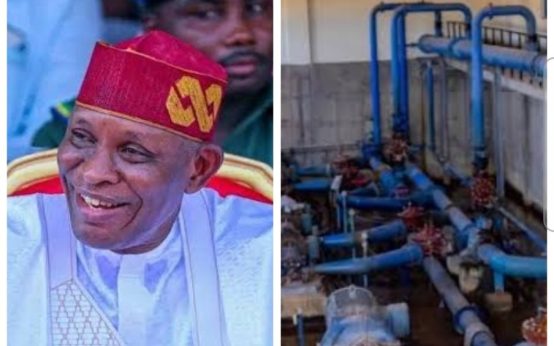 From Dry Taps to Renewed Hope: Abba Kabir Yusuf’s Drive to Restore Water Supply in Kano
  Muhuyi’s Assignment, Abba’s Edge: How Anti-Drug War Reshapes Kano’s 2027 Race.
  Waiya Unveils Nigeria Forward in Abuja to Mobilise Support for Tinubu’s Reforms
  Investing in Minds, Building Kano’s Future: Abba Kabir Yusuf’s Human Capital Development Drive
  KANET to Host Kano Drug Task Force Chairman Barrister Muhyi Magaji Rimin Gado at Monthly Lecture
  CP Bakori Charges Kano Police Commanders on Neutrality, Professionalism for 2027 Elections
  Governor Yusuf unveils 50 vehicles donated to APC campaign in Kano
  Rabid dog bites 18 in Kano community
  FGN/IFAD- VCDP, Taraba govt. move to boost personal hygiene for people with special needs
  Kano Govt Suspends Durbar, Horse-Riding Activities Over Security Concerns