
 Admin
Admin
By Rahima Shehu Dokaji, Kano
For Abdurrahman Yusuf Muhammad Shanono, the gold beneath Kano’s soil has been both a blessing and a death sentence waiting to happen.
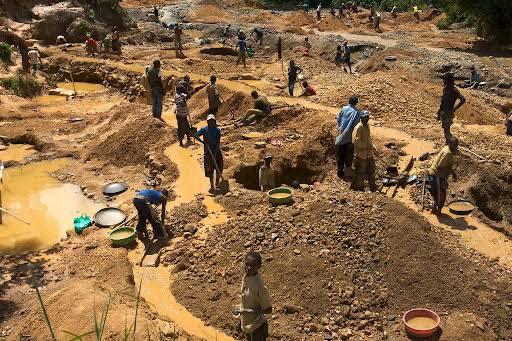
For 10 years, the Shanono indigene has descended into dangerous pits in search of gold, gambling daily with collapsing earth, toxic dust, and suffocating underground heat. Yet despite the danger, he says the business transformed his life.
“One of the best things about this business is its profit,” he said. “You invest almost nothing except your courage and strength. I got married out of the business. I am not into any other business except this one.”
But behind the profits lies a brutal reality.
“It is very risky,” he admitted. “The ground can collapse on you.”
Across mining communities in Kano State, stories like his are becoming increasingly common. Young men plunge 30 feet underground or deeper into unstable pits, searching for gold in an informal industry that offers quick wealth, but almost no safety.
Adamu Ibrahim knows that danger intimately.
The 30-foot-deep holes he enters daily have nearly killed him more than once.
“So many of our colleagues have died in this business,” he said quietly. “It happened to me twice a year ago. The ground collapsed on me while I was trying to come out after finding gold.”
He survived with injuries and what he described as “deep psychological trauma.” Yet, after recovering, he returned to the pits. Why? Because the business built his life.
“I built my house with this business, married two wives with it and achieved many things,” he said.
Chasing Wealth in Kano’s Deadly Gold Pits
Like many artisanal miners, Ibrahim measures fortune in extremes. Some days bring nothing. Other days bring life-changing discoveries.
“I can get up to two million naira, or maybe two hundred thousand, or even nothing.”
For Idris Adamu, the danger comes not only from collapsing pits, but from the machines used to crush stones in search of gold deposits.
“The belt of the engine can slit and harm you to become a cripple,” he said. “Most times it results in death.”
Two months ago, he injured himself while processing stones. Still, the business remains too profitable to abandon.
“On a good day, I can get one hundred thousand naira,” he said. “I got married, built a house, and bought cows for Sallah celebrations unfailingly all from this business.”
Kano’s Expanding Mud Block and Excavation Economy
The same desperation and profit motive driving artisanal gold mining is also fueling another environmentally destructive trade spreading across rural Kano: informal mud and laterite excavation for block-making and construction.
In Gezawa and surrounding communities, the bussiness has become a major source of livelihood for unemployed youths and rural laborers. Large portions of fertile topsoil are stripped daily to produce local building materials, leaving behind expanding pits and exposed land vulnerable to erosion and flooding.
The business is profitable because demand for cheap construction materials alongside rising cement prices and rapid urban expansion continues rising across Kano.
“We cannot stop because this is what feed our children,” said Musa Sani, a 42-year-old mud block trader in Gezawa. Standing beside stacks of freshly molded blocks drying under the sun, he explained that builders especially in rural areas increasingly prefer mud blocks because they are cheaper and keep houses cooler during Kano’s intense dry season.
“People come every day to buy,” he said. “Some contractors even book deliveries weeks ahead because demand is too high.”
Nearby, Bashir Lawan supervised workers loading hundreds of blocks onto a truck bound for a new housing site on the outskirts of Kano city. He said the business has expanded significantly over the past five years as economic hardship pushes more people toward affordable building materials.
“With cement prices rising all the time, many people in rural and some parts of urban areas have no option,” Lawan said. “Mud blocks are cheaper, faster to produce and available almost everywhere.”
For young men with few employment opportunities, the trade has also become a major source of income.
“This work is hard, but it gives us daily money,” said 29-year-old Ibrahim Garba, wiping sweat and mud from his hands. “Even graduates now come here looking for work because jobs are difficult to find.”
A Slow-Moving Environmental Catastrophe
However, what appears at first glance to be ordinary economic activity is quietly becoming a climate and environmental catastrophe.
Climate experts warn that both artisanal mining and informal earth excavation are accelerating land degradation, destroying vegetation, worsening erosion, and increasing Kano’s vulnerability to climate change.
Dr Murtala Uba, a climate expert at Bayero University, said the economic benefits of the businesses cannot hide their devastating long-term consequences.
“The positive is that it generates income and jobs,” he said. “But the negative impacts include land degradation, deforestation, water pollution, exposure to hazardous chemicals, respiratory diseases, and serious erosion.”
According to him, the destruction extends far beyond the immediate mining sites.
When vegetation is stripped and topsoil removed, the land loses its natural protection against heavy rainfall and flooding. Excavated pits collect stagnant water, creating breeding grounds for mosquitoes and increasing disease risks. Unregulated digging destabilizes entire landscapes, making them more vulnerable to collapse and erosion.
Globally, scientists have repeatedly linked land degradation and deforestation to worsening climate impacts. The Intergovernmental Panel on Climate Change warns that damaged ecosystems significantly increase vulnerability to floods, extreme rainfall, desertification, and food insecurity.
946 Erosion Sites and a State Under Pressure
In Kano, the evidence of that environmental breakdown is already visible.
Mahmud Abba, Executive Secretary of the Kano State Watershed and Climate Change Management Agency (KN-WECCMA), revealed that a statewide survey conducted in 2024 identified 946 erosion sites across all 44 local government areas of the state. More alarming, over 460 of those sites were classified as severe or very severe.
Entire communities are increasingly surrounded by expanding gullies, collapsing farmland, and abandoned excavation pits that deepen during every rainy season.
Abba identified Minjibir, Garko, and Gwarzo as some of the worst affected areas.
Yet, while he acknowledged that artisanal gold mining contributes to environmental degradation, he argued that laterite digging, sand excavation, and mud extraction for construction are more significant drivers of erosion in the state.
That distinction may matter little environmentally. Whether the land is excavated for gold, road construction, or mud blocks, the result is often the same: vegetation disappears, topsoil is destroyed, drainage systems are altered, and landscapes become vulnerable to collapse.
Abba himself admitted that construction companies and informal excavators frequently abandon large excavated areas without reclamation.
“You will find a lot of abandoned ditches created as a result of excavation,” he said, citing roads linking Wudil, Gwarzo, Zaria, Kura, and Garun Malam.
These abandoned sites continue expanding year after year, swallowing farmland and threatening nearby communities.
“And causes loss of life of people and animals,” he added.
Weak Enforcement and a Growing Crisis
What makes the situation more troubling is the apparent absence of effective regulation.
Abba admitted he was unaware of any formal law specifically regulating artisanal digging for gold, sand, or laterite in Kano, even though Nigeria possesses broader environmental and mining regulations at the federal level.
On the other hand, Dr. Uba believes the core problem is not the absence of laws, but the failure to enforce them.
“The business is largely informal,” he said. “There is need to formalize it for regulation. Whoever mines has the duty to reclaim the land.”
As temperatures rise and rainfall patterns become increasingly unpredictable across northern Nigeria, degraded land becomes more vulnerable to flooding and erosion. Heavy rainfall hitting exposed soil rapidly washes away farmland, deepens gullies, and destroys infrastructure.
The environmental damage also threatens Kano’s agricultural future. Millions of rural residents depend on farming and livestock for survival. But soil erosion, deforestation, and land degradation reduce agricultural productivity, weaken food security, and intensify rural poverty.
Ironically, that poverty then pushes more young people toward the very extraction activities worsening the crisis. It becomes a vicious cycle: economic hardship drives destructive mining and excavation, environmental degradation worsens climate vulnerability, and climate impacts deepen poverty further.
Government Response
Dr. Muhammad S. Khalil, Executive Secretary of KN-WECCMA said erosion mapping has now been conducted across all 44 LGAs, while intervention projects have been completed in parts of Ungoggo and Sumaila.
But he acknowledged the enormous financial burden involved. According to him, each erosion intervention costs at least ₦150 million. That means the government faces an almost impossible challenge: containing hundreds of severe erosion sites while environmental destruction continues expanding daily through unregulated excavation and mining.
Experts insist that unless the state aggressively enforces environmental regulations, mandates land reclamation, and formalizes the extraction sector, the crisis will continue to spiral.
For now, however, survival still outweighs sustainability for many miners. Every morning, men continue descending into unstable pits beneath Kano’s earth, chasing fortunes buried in dangerous soil. And with every hole dug deeper into the land, the state’s environmental future grows more fragile.
 Massive Turnout in Kiru/Bebeji as Abdulmumin Jibrin Kofa Secures Affirmation for Fifth Term Bid
  Weddings of Hope: How Amina Namadi Is Changing the Lives of Orphans in Jigawa
  Victory Smiles
  Jigawa First Lady Applauds Corps Members at NYSC Orientation Camp Cultural Display
  Pulse Nigeria Apologises Over Misleading ‘Underwear Distribution’ Report following Kano Development Forum’s Intervention
  Tarauni Breathes As Ja’o’ji Advances
  When Ja’o’ji Answers Reconciliation With Humility in Victory
  APC Aspirant Raises Concerns Over Conduct of Primary Election in Jigawa Constituency
  Kano Govt Pledges Stronger Collaboration with FG, Partners on Education
  Ambassador Dr Amina Umar Namadi Sponsors Mass Marriage for 300 Couples in Jigawa
  Police Warn Against Violence Ahead of APC Primaries in Akwa Ibom
  RFI Hausa to Host Festival, Celebrate Kannywood in Kano